
ANTIQUE SHIP'S MARITIME PELORUS, DRUM COMPASS, HUSUN, HENRY HUGHES - LONDON
£289.99
FREE P&P
Only 1 left - order before it's gone!
Once it's gone, it's gone
Buyer Protected
Fast Dispatch
Secure Payment
ABOUT THIS ITEM
Description
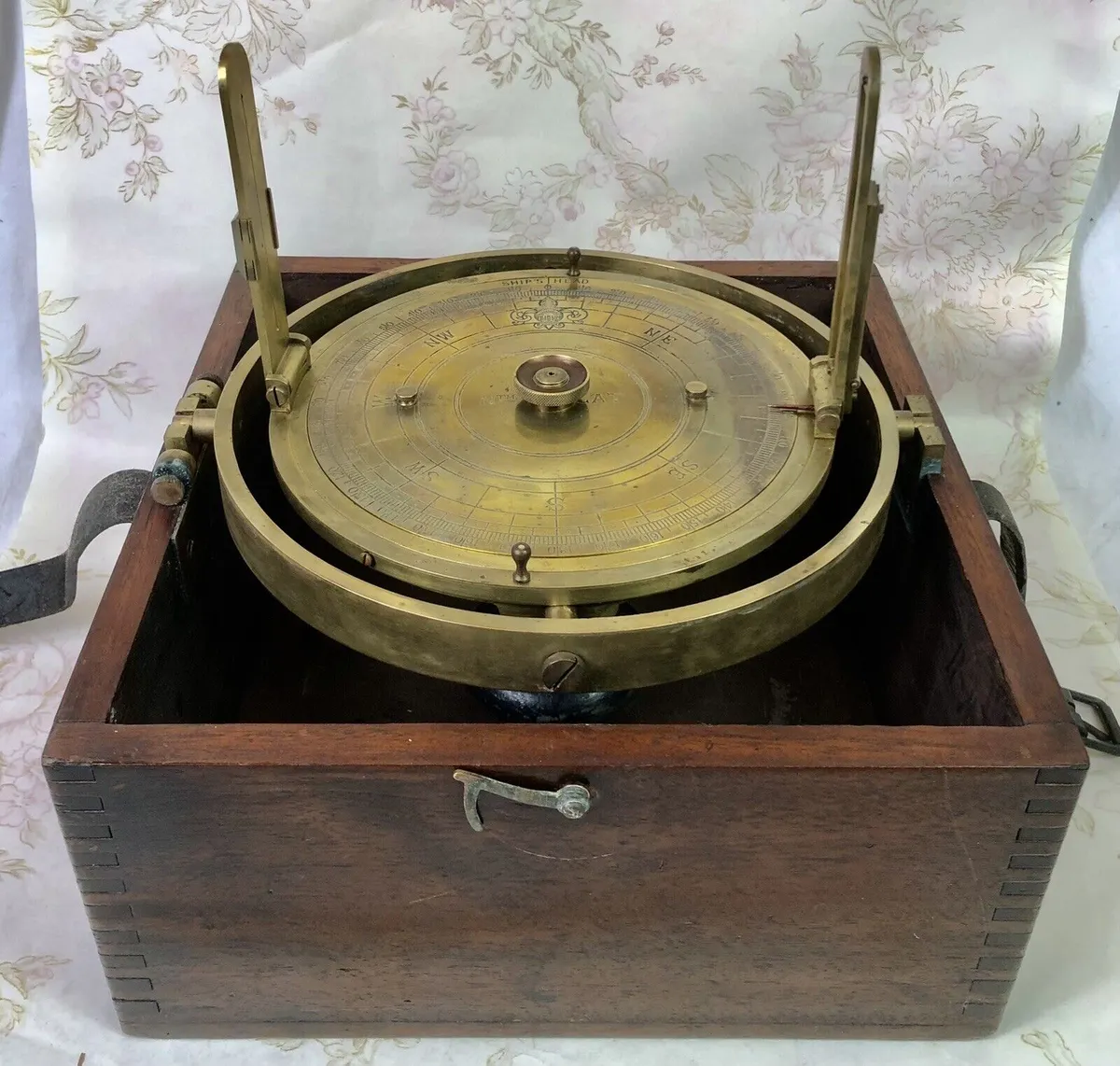
ANTIQUE SHIP'S MARITIME PELORUS, HUSUN, HENRY HUGHES & SONS - LONDON, NAVIGATION, DRUM COMPASS
Very rare maritime collectable, I cannot find another example of this instrument by Henry Hughes.
Original fitted mahogany case 30cm x 30cm x 21cm approx.
Dated around 1880 - 1900
Gimbal ring, overall diameter 24cm
Solid brass, with lead weight
Double sided compass rose South / North
Good condition for age, with some tarnishing, oxidisation, wear, scratches and marks.
The Pelorus was used to take relative bearings in determining a vessel’s position. These bearings are then related to the ship’s heading and the compass bearing of the object sighted is determined. Other applications are listed below:
Determine anchor security- Determine relative bearings change – Predict crossing situations – Plot offshore fixes – Determine compass error by celestial body.
The compass rose is set inside a ring on gimbals with a heavy lead weight in the bottom section so that it remains level during the ship’s movements. Two sighting vanes move together. The viewer’s vane has a sun shade attached. The forward vane had a hairline wire that is lined up on the body. It also has a filter to reduce the brightness of the sun when taking amplitude sights. It is designed to be used when mounted on a pipe stand on the bridge wings
The two sighting vanes are aimed at a terrestrial object with the bearing read off the compass card. These bearings are simultaneously compared to the vessel’s compass heading which then gives the compass bearing to the object. Appropriate adjustment is made for compass error. Bearings of two objects, taken sequentially, will fix the vessel’s position. Similar observations of a rising or setting sun when on the prime vertical allow for determining compass error.
The instrument was named for one Pelorus, said to have been the pilot for Hannibal, circa 203 BC.
Pelorus or Dumb Plate. A dumb compass card (without magnetic needles), or azimuth dial, supported in gimbals and fitted with sight vanes for telling or reading off a bearing.
Hughes and Sons were originally clock makers in the East End of London who later supplied sextants and chronometers to ships coming into the Thames. Partnership headed by Alexander Hughes, son of Henry Hughes (w.1835-79, d.1879). 1879-1941 - Traded at 59 Fenchurch St., London England. 1903 - Incorporated as a limited company. 1915 - Factory at Hainault, London. 1917 - Works at Forest Gate and Ilford, London, England.
The firm of Henry Hughes & Sons was founded in 1828 in London and was incorporated in 1903. They traded many instruments under the brand name 'Husun'. In 1935 S. Smith & Sons Ltd took a controlling interest in the company and instruments traded under both the name of Hughes and Sons as well as Smith Instruments. During WWII a joint venture, Marine Instruments, was founded together with Kelvin, Bottomley & Baird Ltd. In 1947 the company merged with Kelvin Bottomleyamp; Baird Ltd, Glasgow, Scotland to become Kelvin Hughes.
SPECIFICATIONS
Item Details
- Primary Material
- Brass
- Military Branch
- British Merchant Navy
- Object Type
- ANTIQUE SHIP'S MARITIME PELORUS, COMPASS, HUSUN, HENRY HUGHES
- Original/Reproduction
- Antique Original
- Time Period, War
- WWII
- Country/Region
- United Kingdom
- Maker
- Henry Hughes & Sons